
KALA Art Institute Berkeley, CA October 12, 2023, to February 9, 2024
Smart, playful, sexy, and ravishingly sad; Curator Anthea Black has gathered a remarkable collection of 48 works into what amounts to a comprehensive introduction to queer and trans book art and artist publishing spanning 40+ years, with several works per decade. The work is mindfully distributed along axes of scale, medium, use of color vs. black and white, and proximity to traditional book forms. Its central theme is the censorship of queer and trans presence in public culture, which is currently resurfacing with a virulence we haven’t seen since the peak years of the AIDS crisis (roughly 1985–1995). The Embodied Press documents politically-motived cultural suppression as a cross-generational aspect of queer and trans life experience—and also shows it as inseparable from the wild range of abstractions we’ve created in response.
The show develops this theme through contextual material in a print gallery pamphlet and extensive online audio accompaniment accessed through QR codes on the work. It’s a testament to Black’s curatorial skill that the show itself taught me most of what I needed to know to fall in love, and that a range of access-points offered many ways to engage with the ideas in the exhibition.
Too often “curation” refers primarily to the selection of works included and the technical problems of display. The Embodied Press goes far beyond this in the geometrical precision of the paths of movement and vision it created. These pathways approached participatory choreography. At some points I felt like I was becoming a book myself, my pages turning to follow lines of meaning and form off the page to other works. For instance, the back space of the gallery is partially separated from the main room with walls about 8 feet wide. On one of these, Black projected Au Revoir, a two minute performance video by Nadine Bariteau, in which the artist lets an icy wind lift the pages of an unbound book away from her so that they float across a frozen landscape with the airy drift of down. The opposite wall holds some 200 of these pages, tacked in overlapping floor to ceiling rows at the same scale as the projection. The French phrase “au revoir” repeats endlessly on this giant paper wing. I could understand its grief and myself as standing in its center, folded in and framed by pages whose evanescence spans dimensions and temporalities.
When I was finally ready to move on from Bariteau’s feathery experience I turned to find that walls facing me also held video works, spaced so that the three of them composed a triangle. A tiny monitor was partitioned from the white and blue sadness of Au Revoir by a giant cutout black paper swag hung from the ceiling. Titled Dick Grab, this garland depicts a pair of big gay bear-bodies connected by their hands on one another’s dicks. Repeated like a chain of paper dolls, this installation echoed the black curtains that once covered the entrances to the smutty sections of video stores and the back rooms of leather bars. Beyond it, a wall-mounted screen played a 2007 black-&-white video by Malic Amalya. FlyHole loops a series of slides from a zine made from cutout pieces of a 1986 gay porn magazine. If you watch it long enough (you’ll want to), it tells the story of a fly on the wall in a gay bathhouse, who falls in love with a hunky guy it cruises there and transitions to human form in order to consummate that love.
A sign on the gallery wall warns you that FlyHole is going to be explicit. In contrast to Au Revoir, FlyHole is readily available as ammunition in contemporary conversations about “appropriateness” that seek to curtail trans and queer existence. (While it’s operating at a scale that makes that unlikely, it’s worth remembering that the same was true of the Ron Athey, Andre Serrano, and Karen Finley works that were used as justification for the near eradication of public funding for the arts through the 80s and 90s.) In conversation with Au Revoir, we’re asked to recognize that Amalya’s sexy oddball video is also a document of loss and longing. The public sexual culture it might appear to document had already been shut down in 1986, and most of its participants are now dead; the magazine from which it’s made has been destroyed in the making; and we can’t be certain that the fly actually achieves its end, which may after all be a fantasy.
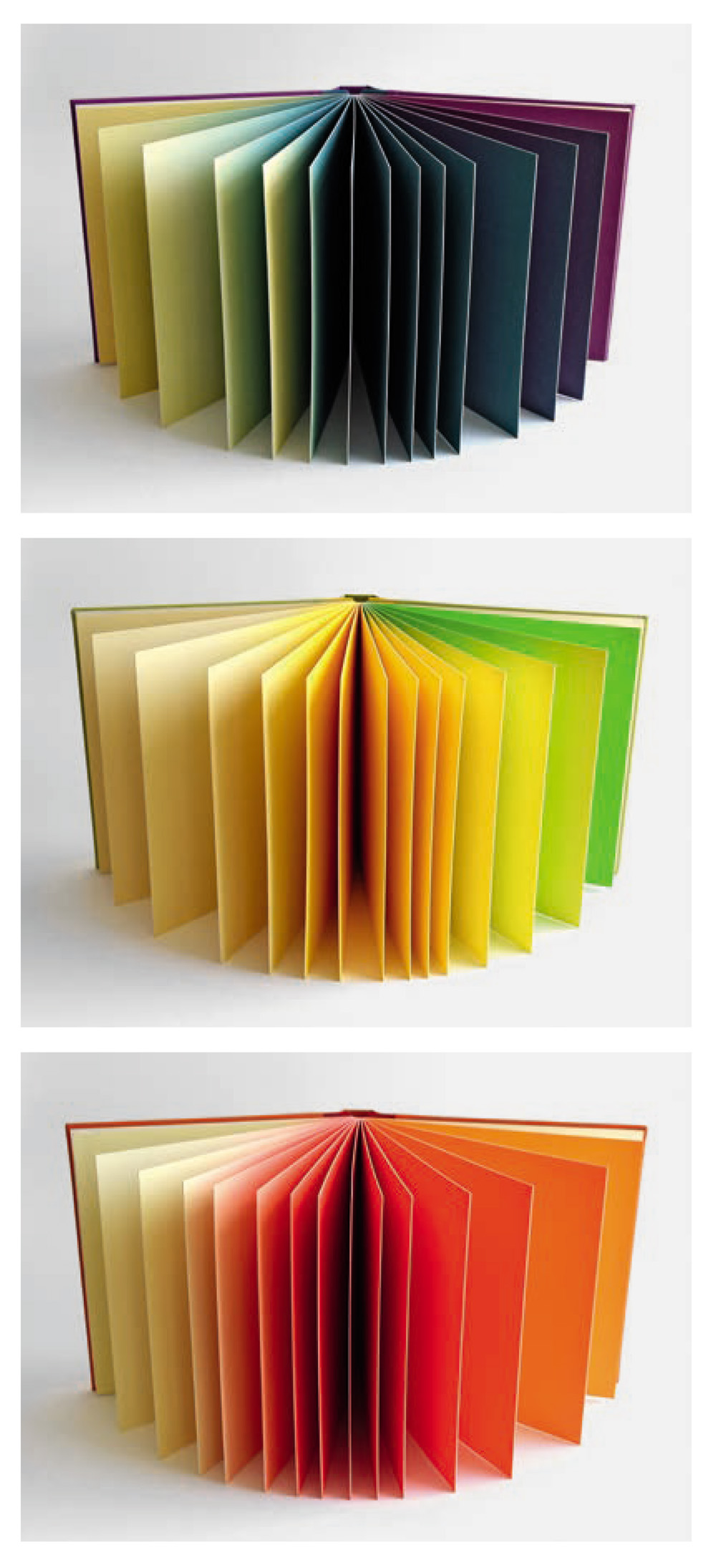
Three books from Nick Shick’s color field series, Radiate, Vol. 1–12. PHOTO COURTESY ANTHEA BLAC K AND THE ARTIST
Leaving the back room, I was stopped in my tracks by a sudden jolt of color: a matched pair of books standing back to back, each fanned open to display waves of pigment that would make a peacock green with envy. Nick Shick’s series Radiate, Vol. 1–12, 2019–present, is perhaps the most rigorously abstract work in this show. The pages are pure color-fields with no visual or formal hierarchy of layout to guide you as you read; you have to take these books on their own terms, accepting change as the colors transition with the kind of ombre nobility you’d expect from a rainbow but following the logics of some other spectrum. Such rigorously minimalist abstraction could be a barrier to entry. It had the opposite effect on me. I felt myself opened by the books. I wanted to open them further in return. I felt a need to fondle them and flip their pages: I sensed that the coded information these books hold must exceed their hues, must come through the weight of the ink and the paper’s texture under your hands.
Unlike Amalya, Shick could evade harassment by the nastiest book-burning funding-yanker in Washington: Radiate offers no representational narrative of queer eroticism, no figuration to anchor a charge of obscenity. They aren’t even as dangerous as gay rainbows. Nevertheless, if you know the codes, Radiate is as carnal as they come. It is the tangible trace of its own process of materialization. Each work was printed in one shot. They are a record of the body standing at the press, a document of how the color changed and moved on the rollers over time. Like FlyHole, these works refuse and refute any attempt to bind them as narratives between the boards called “beginning” and “end”. Also, like FlyHole, they show trans becoming by stepping back from the human body as the subject of gender and desire; and perhaps both are responding to the dehumanization to which we queer and trans people are subjected.
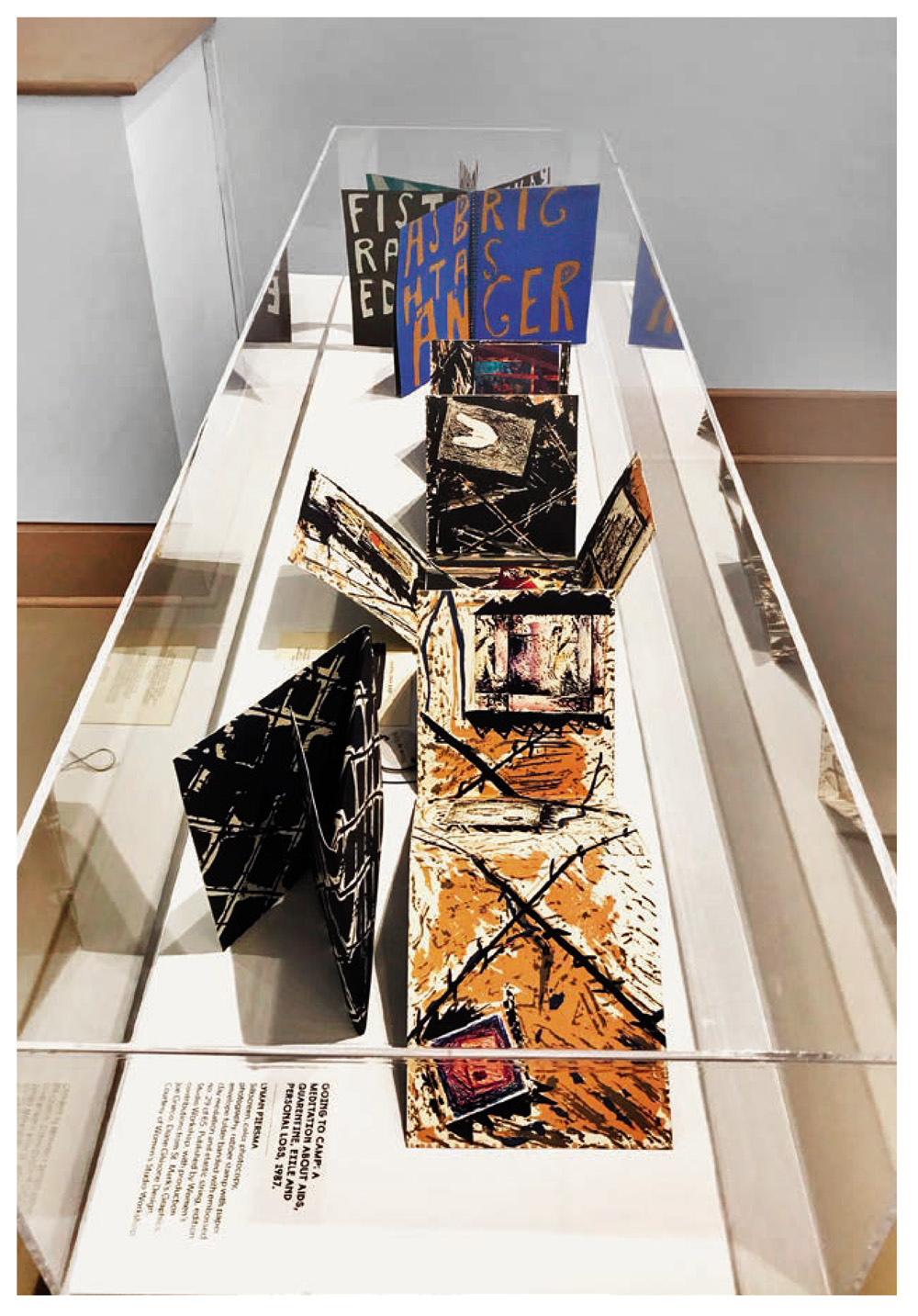
Installation view of Lyman Piersma’s Going to Camp: A Meditation about AIDS, Quarantine, Exile and Personal Loss. PHOTO BY ALEC LOGAN SMITH, COURTESY WOMEN’S STUDIO WORKSHOP
I’ve focused on these three artists to illustrate my point about the precise geometry of Black’s curation and the way it works to connect and contrast medium, color, and mood. Other works in The Embodied Press are equally strong, but to me the single most powerful piece is also the one that was at the literal center of the exhibition, where all the sightlines intersect: the 1986–87 Going to Camp: A Meditation about AIDS, Quarantine, Exile and Personal Loss, by Lyman Piersma. This small, rather humble, limited-edition screen printed piece, made the year before the artist died, depicts mass internment of gay men in the name of protecting the social body from infection by diseased perverts, and implicitly asks its readers what they will try to bring with them. It is an intensely painful work. It’s also historically important: it is the first artists’ book explicitly about HIV/AIDS, and one of the most explicit about the political terrorism waged against queers by the US government, with generous support from the mass media and both Catholic and fundamentalist Christian churches. Perhaps that complicity informed the book’s structure: when fully opened, the pages form a cross. Black treats Going to Camp as a sacred text, presenting it gently lit and low to the ground; I had to kneel to see it properly, and once there felt drawn to contemplate the weight of a generation’s death on my shoulders.
But when I stood up: there I was, looking into the back room that’s part fuck club and part temple, Dick Grab framing FlyHole on one side and Au Revoir on the other, queer and trans bodies reflecting and multiplying in the intimacy of a culture shaped by the shared trauma of mass queer and trans death in the 1980s, and by our shared determination not to give in, not to disappear through death or hiding, but to touch ourselves and one another into the fulness of our being at every scale, in every medium, through every binding.